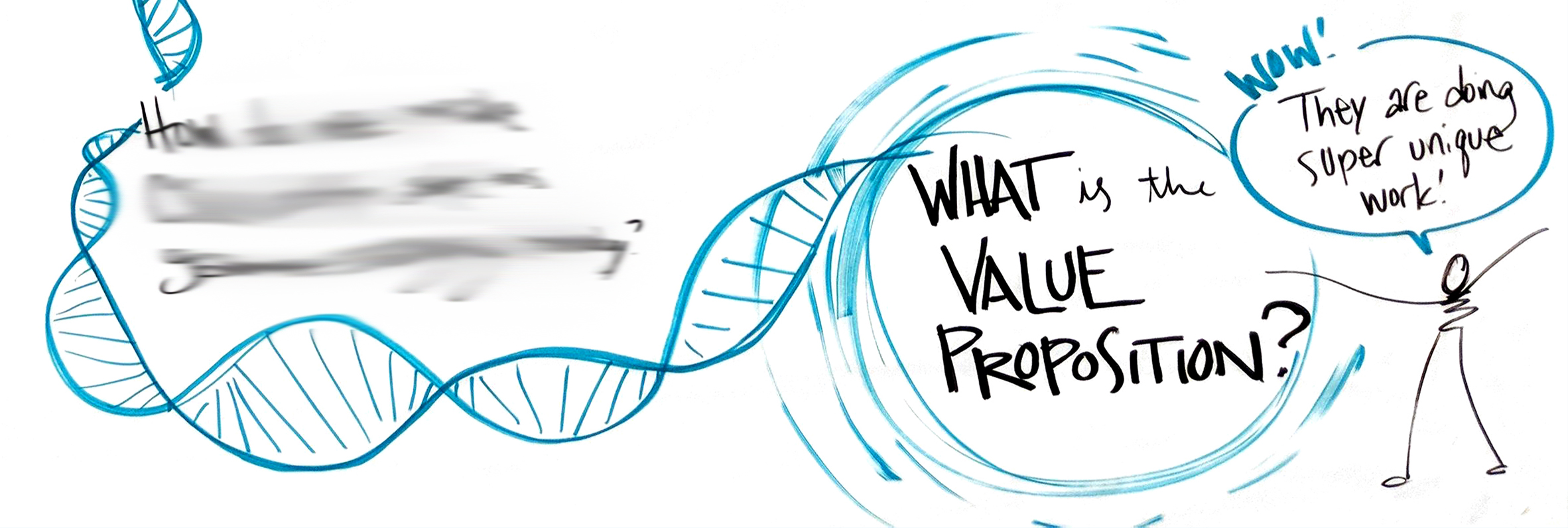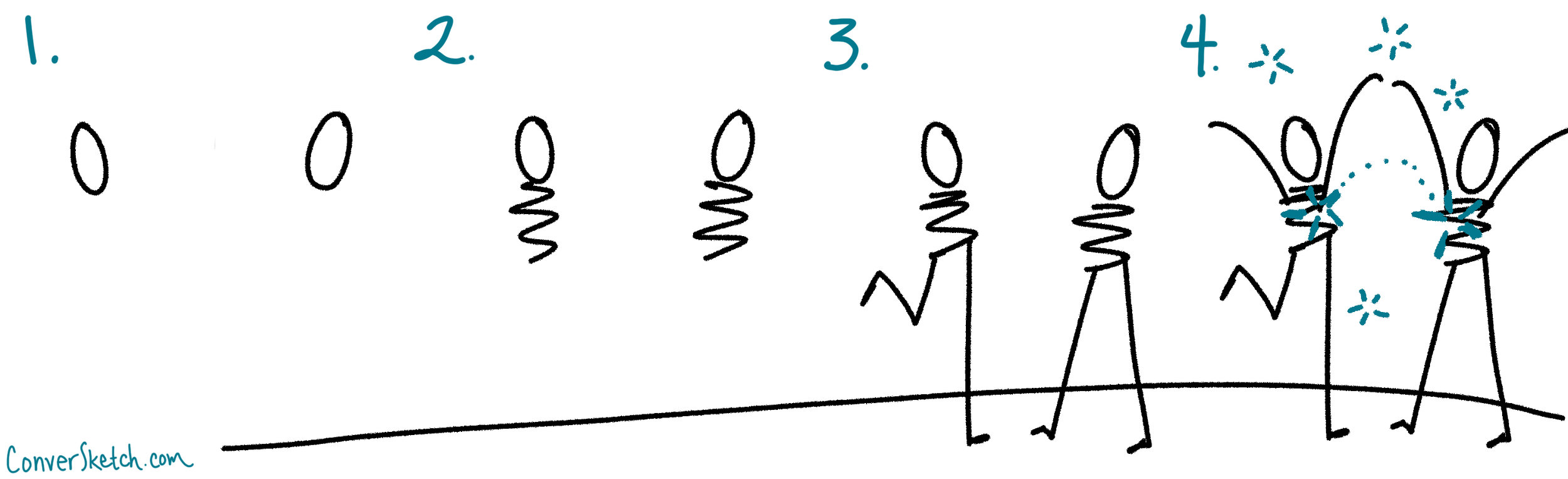
graphic recording

We Had A Kickass Retreat. Now What Do We Do with Those Drawings?

You pulled it off.

The right people in the room, excellent process design, a location that stimulated creativity and collaboration, excellent food. You even had a graphic recorder visually capture the conversations for you, which captivated participants and helped them see connections and build ownership of the ideas generated. The retreat. Was. Amazing. Everyone left feeling energized, with clear direction and shared understanding about where you’re headed and why.

Now what?

Aside from a cold beverage to celebrate pulling off such a stellar event, you know that you’ve got to figure out a way to keep participants motivated and energized after the retreat. How can you make sure they don’t get distracted with the day-to-day urgency of their work, and are able to keep the clear vision and energy front-of-mind?

Lucky for you, when the retreat is over, my job isn’t. The visual charts that are created are incredibly useful during, and also after the event. That’s why I create a custom list of suggestions to use the charts after the event, tailored to each of my clients’ needs and goals.  

And today I’m going to give you a sneak peek into what goes into them. A huge shout out to Lisa Arora for the framework I’m about to share.

4 P's of using a graphic recording chart after the event

Once again, thank you from my heart and soul for your support, great senses of humor, brilliant minds, collaboration and what you're each doing to make the world a better place.

Cheers, Karina

Want to get more ideas for how to use your charts after an event? Let’s put your visual meeting notes into action for your organization!

Cheers!

Where in the World is ConverSketch?

In the Studio: Filming videos for the National Park Service and US Forest Service about climate change and wildfire risk planning. Things are heating up around here!

In the Studio: Filming videos for the National Park Service and US Forest Service about climate change and wildfire risk planning. Things are heating up around here!

Albuquerque: To graphic record for a women’s health mentorship program. Looking forward to cactus and desert vibes.

Albuquerque: To graphic record for a women’s health mentorship program. Looking forward to cactus and desert vibes.

How to Get People So Excited to Participate in Your Event They’ll Be Talking About It for Weeks

There’s this thing I’ve noticed about people: we love ourselves. Now, wait a minute, just hear me out on this one, okay?

Even if you’re the most generous, self-aware, kind and thoughtful person, you will almost certainly get a kick out of seeing yourself as a little roughly drawn character, especially if you get to watch while it’s drawn. And if we get to see how our experiences and stories compare to those around us, we get even more interested.

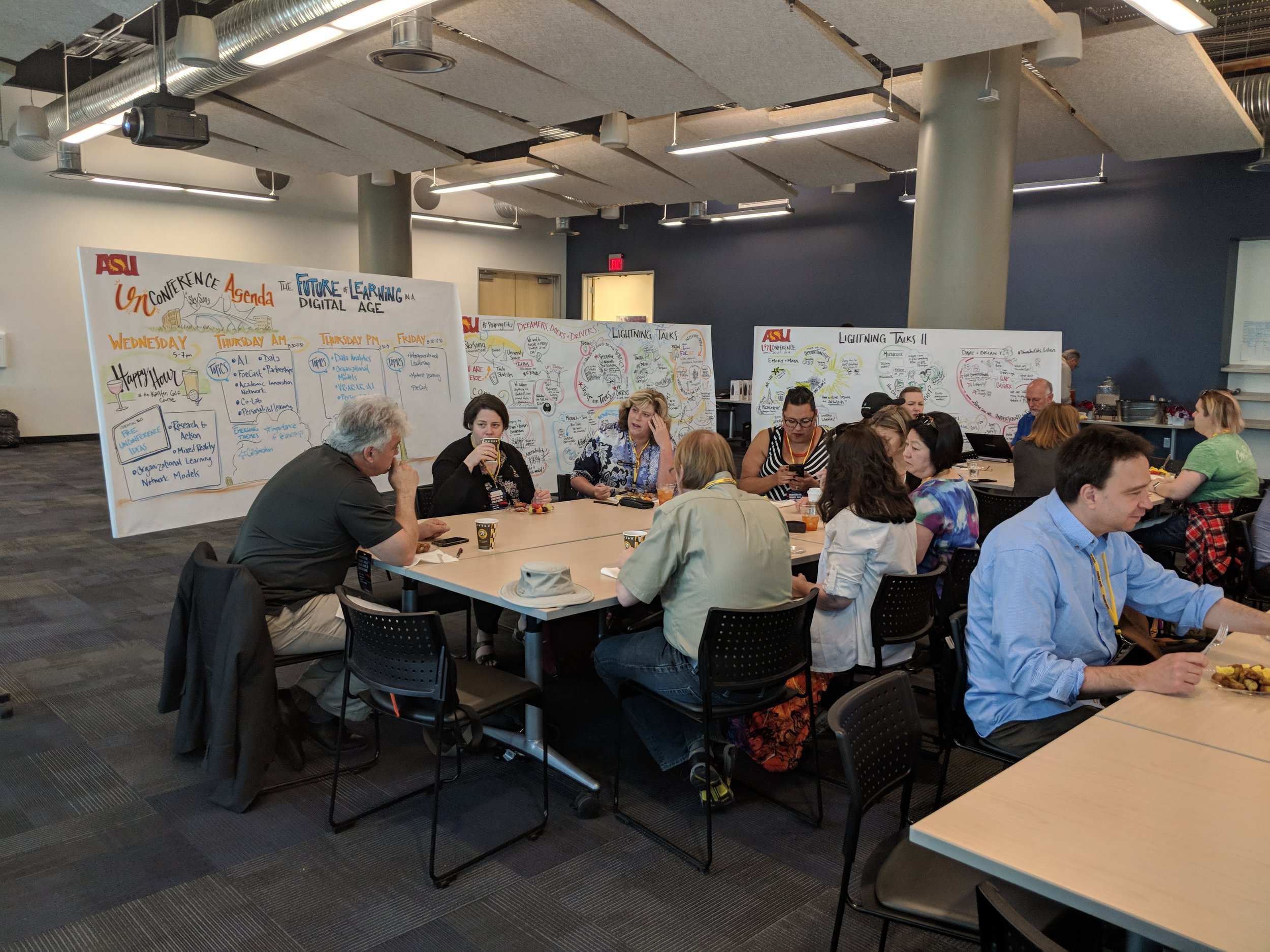
Last week I created a Story Wall for the Arizona State University Unconference on the future of learning in a digital age. During happy hour, I talked with about 100 people about when they first became involved with digital learning and drew their stories for them while they watched. It was rapid-fire with people clustered around, waiting to have their story captured and perhaps a picture drawn. It was messy and unfiltered.

Everybody loved it.

I heard things like “You learned that software program too?! Do you remember…” Old friends and new friends were standing shoulder to shoulder, watching and chatting.  And it wasn’t just during that first happy hour – for the rest of the two day Unconference, people were continuously gathering around the Story Wall and talking with each other.

These Walls lead to direct opportunities to connect face-to-face in an authentic way, something we seem to be craving more and more in this increasingly technological world.

As a graphic recorder, I am always trying to improve how I listen, how I draw, how I make marks to capture not only content, but the energy of the room. Which sometimes leads me into the Art/Design Rabbit Hole of Continuous Creative Improvement, and I forget the most important thing about what I do: It’s not about me or how “pretty” the drawing is. It’s about helping my clients see and understand their stories.

Once again, thank you from my heart and soul for your support, great senses of humor, brilliant minds, collaboration and what you're each doing to make the world a better place.

Cheers, Karina

Want to boost engagement and creativity at your next event?

Let’s Build A Story Wall

Where in the World is ConverSketch?

Arizona State University: Unconference for Dreamers, Doers and Drivers around the future of digital learning in higher education.

Arizona State University: Unconference for Dreamers, Doers and Drivers around the future of digital learning in higher education.

Colorado State University: Last week CSU hosted a University-wide, then community-wide event around how to cultivate compassion in the workplace. After a presentation from researcher and thought leader Leah Weiss on the power of purpose and compassi…

Colorado State University: Last week CSU hosted a University-wide, then community-wide event around how to cultivate compassion in the workplace. After a presentation from researcher and thought leader Leah Weiss on the power of purpose and compassion in the workplace, the participants discussed what they wanted to see and what they can do where they work.

How to Move Beyond Old Patterns in Conversation

Have you ever noticed patterns of communication in groups you spend time with?

Are there certain people you feel like you have really productive and enjoyable conversations with? How about the other end of the spectrum; you know when you get into a discussion with a particular group of people that it will inevitably be frustrating or murky?

During Kelvy Bird’s Visual Practice Workshop earlier this year, she shared a model called the Four Players in Conversation, developed by David Kantor. The premise is that in every conversation, people play one of four roles:

Move: to initiate, set direction

Follow: to support and complete an initiative

Oppose: to challenge and correct

Bystand: to witness and offer perspective

Which Player do you tend to embody? What kinds of questions or statements are you making? How is that affecting the group and conversation?

Personally, I tend to gravitate away from the role of the Opposer, but during the workshop someone offered a perspective that fundamentally shifted my negative association with it. They clarified that to Oppose does not necessarily mean to be aggressive or contrary, rather it creates a space for questions and critical thinking if approached in a compassionate way.

As a graphic recorder, this lens is an area I’m stretching myself to leverage more to better support the groups I’m working with. How can what I capture solidify or open the conversation to serve the group and their goals? Which Players are being heard, and which are absent? What does this mean for the group? For the graphic?

conversketch-four-players-in-conversation-graphic-facilitation

Once again, thank you from my heart and soul for your support, great senses of humor, brilliant minds, collaboration and what you're each doing to make the world a better place.

Cheers, Karina

Want to see your group's patterns? Let’s put the science of conversation into action for your organization.

Let’s Talk

Where in the World is ConverSketch?


In the Studio: Last week I wrapped up the third Drawing Connections video for the National Park Service Climate Change Response Program. This video will take you through the seasons at Yosemite National Park! Click here to see the Fort Laramie video…

In the Studio: Last week I wrapped up the third Drawing Connections video for the National Park Service Climate Change Response Program. This video will take you through the seasons at Yosemite National Park! Click here to see the Fort Laramie video, and here for Cabrillo.

Colorado State University: Helping researchers working with gene editing think strategically about research priorities and partnerships.  

Colorado State University: Helping researchers working with gene editing think strategically about research priorities and partnerships.  

Happy New Year from ConverSketch

Hello!

I hope this finds you rested and enjoying time with loved ones this holiday season. I am full of appreciation for the incredible clients I’ve had the pleasure and honor of working with this year. I am in awe of all the groups doing important work I’ve been in the room to support visually.

Even though the holidays can be a busy time, I love the quiet reflection afforded by long nights or the muted quiet of the earth blanketed with gently falling snow. Each year around this time, I like to spend time reflecting on my business and life: what worked, what I’d like to change, and putting my vision for the next year on paper – here’s a post about my visioning process and inspiration.

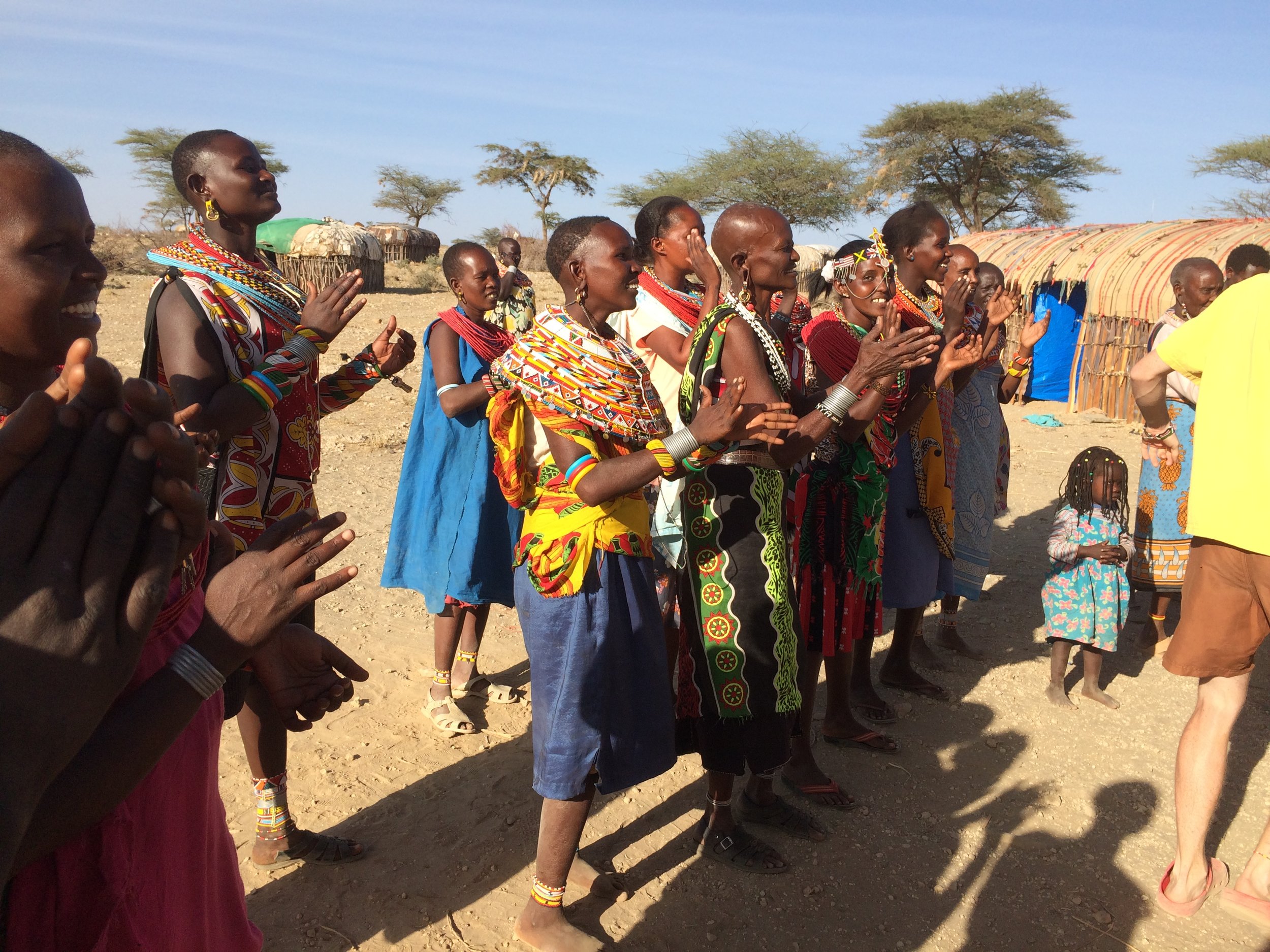
I also have the pleasure of taking students from Colorado State University on a two-week volunteer tourism trip to Samburu, Kenya each year over their winter break. We leave tomorrow and will be spending our time learning about a completely different culture, working with a Women’s Village called Unity to build huts or shade structures (whatever they need!), teaching in the primary school (more or less), working with youth who have received scholarships to attend secondary school and celebrating recent graduates, and taking children on wildlife-viewing drives to talk about the importance of conservation. This place and these people are incredibly important to me and as part of ConverSketch’s values, I serve on the advisory board of the Samburu Youth Education Fund which provides the aforementioned scholarships, as well as make donations each year to supporting the youth and entrepreneurial endeavors of Unity Women’s Village and their beading.

unity-womens-village-samburu-kenya

Although the access to connectivity and technology in this rural community has grown over the seven years I’ve been visiting, wi-fi still isn’t reliable or pervasive, and I won’t have cell service while we’re in Archer’s Post. I’ll be responding to any messages after January 12th, 2018. Thanks in advance for your patience!

Wishing you and yours a New Year filled with Abundance, Joy, Light, Laughter, Adventure and Love.

Once again, thank you from my heart and soul for your support, great senses of humor, brilliant minds, collaboration and what you're each doing to make the world a better place.

Cheers, Karina

Where in the World is ConverSketch?

Arizona State University Technology OfficeI spent the day in Tempe working with the new leadership team for ASU’s Office of Technology as they defined their vision, values and how they wanted to work together to move from a group to a rockin’ team.

Arizona State University Technology Office

I spent the day in Tempe working with the new leadership team for ASU’s Office of Technology as they defined their vision, values and how they wanted to work together to move from a group to a rockin’ team.

In the Video StudioI’ve been working with the Wildfire Research Team (WiRe) for the past year developing a series of videos about their work to help communities become more fire adapted. The last video of the series is in the final stages of approva…

In the Video Studio

I’ve been working with the Wildfire Research Team (WiRe) for the past year developing a series of videos about their work to help communities become more fire adapted. The last video of the series is in the final stages of approval, and I’ll look forward to sharing the series in the beginning of 2018!

Annual Gratitude Shower of Goodness

Hi Blog Readers,

I am SO GRATEFUL you're here!

This is one of my favorite posts to write, because if there’s one thing I know, it’s that having an Attitude of Gratitude makes life absolutely splendid (also, if you click that link you can learn to draw a turkey!).

Time and again, when I’m focused on appreciating, that’s when I tend to attract exactly what I need. And the more I practice being grateful, the more I want to give!

There are a limitless number of ways you can cultivate an Attitude of Gratitude. Sometimes I make a list (love those), sometimes Spencer and I will go back and forth sharing things we’re grateful for when on a long drive, and sometimes I think about it when I’m exercising or painting.

This year, I want to give you a little Gratitude Doodle. You can write, draw, doodle, leave it blank and just think about what you’re grateful for… this downloadable image is for you (right click, save and print!)!

conversketch-gratitude-visual-fun-sheet

Once again, thank you from my heart and soul for your support, great senses of humor, brilliant minds, collaboration and what you're each doing to make the world a better place.

Cheers, Karina

Want to thank your people? Let’s talk about how to use visuals to create meaningful gifts for speakers, employees, bosses, and more!

Let’s Do This.

Where in the World is ConverSketch?

The Studio

This week and last have been full of a big studio project for Colorado State University’s new Women and Philanthropy initiative. I’ve been listening to focus groups of women of different generations (Traditionalists to Generation Z) and capturing them visually. These illustrations will be used to show themes and inform the University about how women want to give back!

New Mexico

Today I’m headed to Albuquerque to graphic record for the New Mexico Breastfeeding Taskforce Summit – they’re all about providing resources to hospitals, clinics and other healthcare hubs to support breastfeeding mothers.

How to Stand Out in A Sea of Booths

The Trade Show. A massive room filled with hundreds of booths, all wanting to lure in the same passers-by.

Most booths are using the same old methods they always have: the freebies, candy, “try our product!” to nab attention. There are trinkets everywhere. By the end of the day all you see is a glazed look on attendees’ faces as they attempt to find the exit (and preferably the nearest bar).

There’s something missing from this scenario. Something that can set you up for authentic connections and hook your potential clients.

Here’s the secret: people don’t just want a sales pitch, they want to be heard. They are yearning for genuine human connection in a sea of people trying to get their business.

Secret Part Deux? You can have it all: listening to your customers, interactive and engaging displays, freebies, and authentic human connection.

All you have to do is partner with a graphic recorder.

I love chatting with attendees, asking for their ideas, and seeing them light up as they watch their story come to life. Then they want a photo with their drawing, which is the perfect opportunity to ask them to tag the business I am working for when they share it on social media. Boom.

Bonus: Major human connection opportunities, and if you play your cards right, you can get valuable market research data collected in real-time.

ConverSketch-learn-to-draw-human-connection

Once again, thank you from my heart and soul for your support, great senses of humor, brilliant minds, collaboration and what you're each doing to make the world a better place.

Cheers, Karina

Heading to a trade show next year? Let’s make a plan to help you stand out in a sea of booths!

Yes!

Where in the World is ConverSketch?

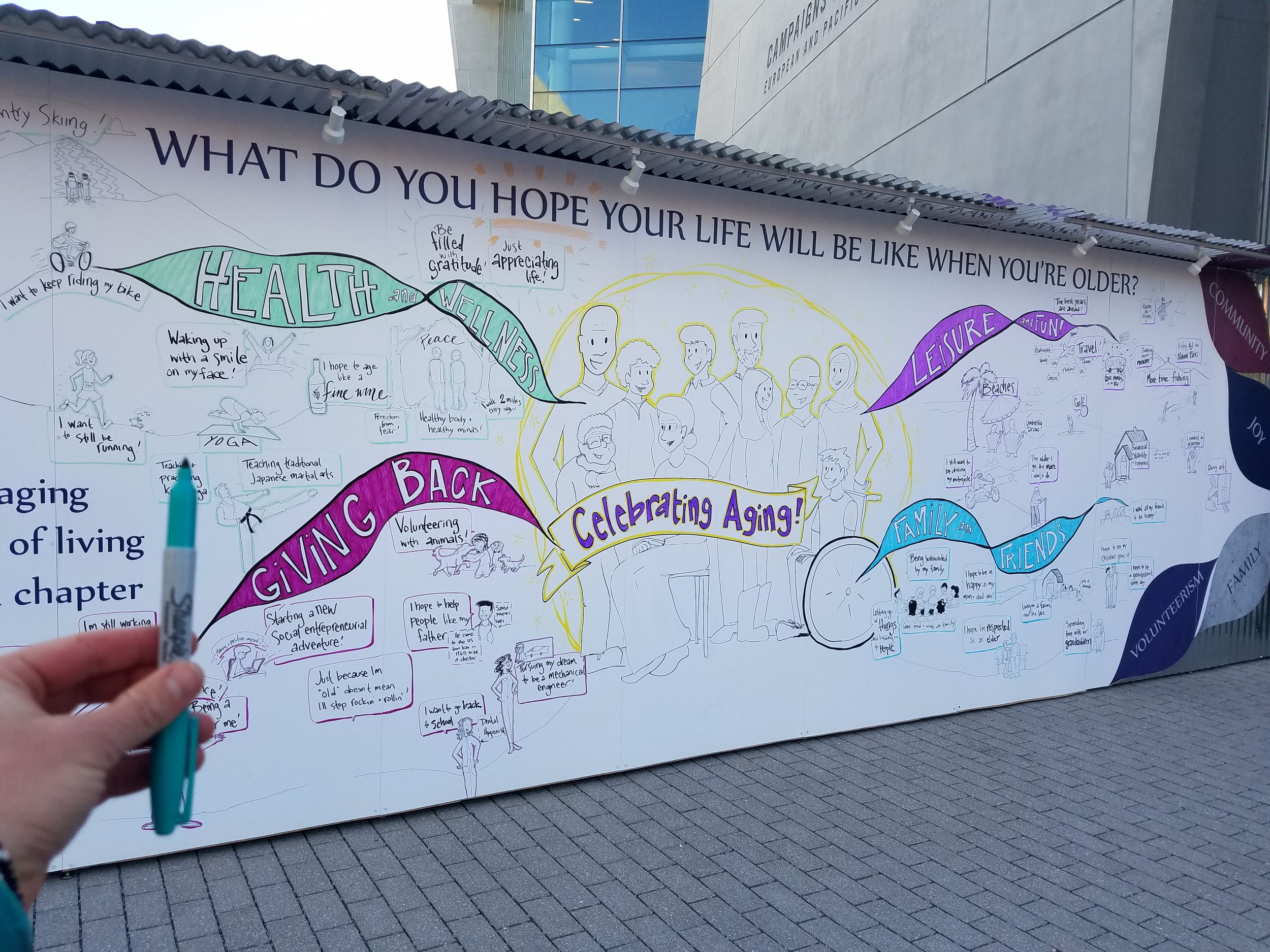
New Orleans with LeadingAgeI spent last weekend outside the National WWII Museum gathering stories about how visitors wanted their lives to be when they got older. From "no regrets" to "aging like a fine wine", I captured visual stories over the two…

New Orleans with LeadingAge

I spent last weekend outside the National WWII Museum gathering stories about how visitors wanted their lives to be when they got older. From "no regrets" to "aging like a fine wine", I captured visual stories over the two days!

Nashville with GatesToday I'm headed to Nashville to do some more story capturing for Gates. We haven't started yet, but here's a snippet from work I did with them earlier this fall!

Nashville with Gates

Today I'm headed to Nashville to do some more story capturing for Gates. We haven't started yet, but here's a snippet from work I did with them earlier this fall!

How to Make the Most of Working with a Graphic Recorder

So you’ve decided to bring in a graphic recorder to support your team to be more focused, creative, collaborative and engaged? High five to you! You’re making an investment that will not only elevate the group during the meeting or event, but can also have long-lasting positive impacts.

Here are some tips I’ve compiled from working with my wonderful clients over the past 5+ years that can help you get the most out of working with a graphic recorder.

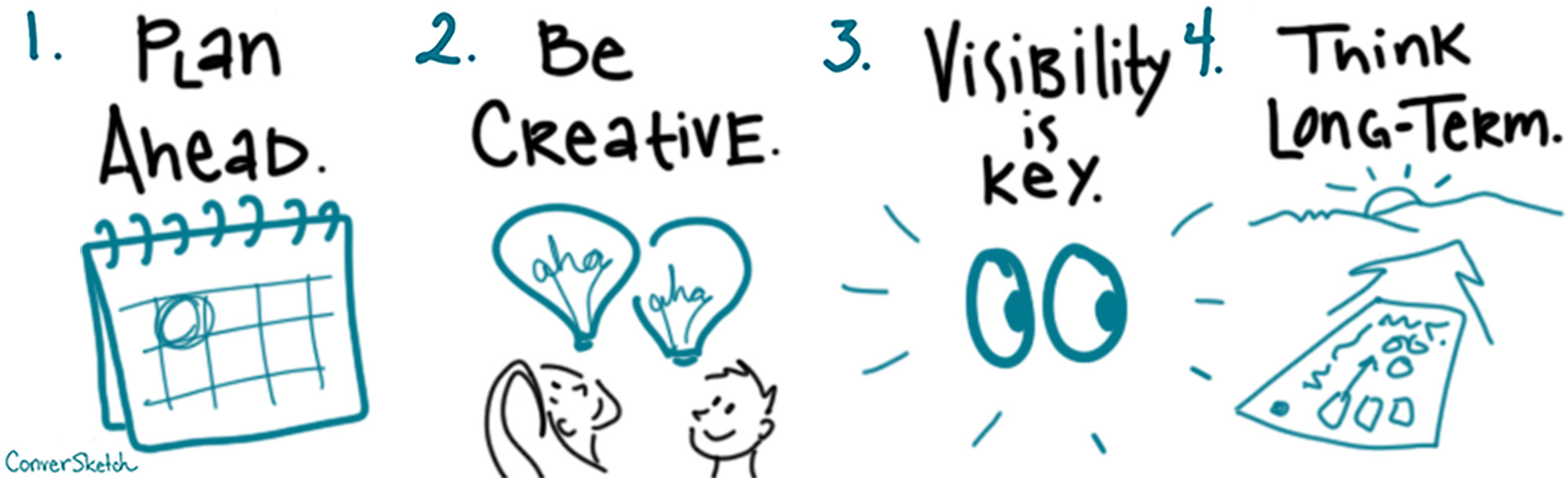
ConverSketch_how-to-make-the-most-out-of-working-with-a-graphic-recorder

Plan Ahead.

Graphic recorders know when and where they can be most useful for the group, or the kind of visuals that a group might need to do their best work. Bringing in a graphic recorder while you’re still developing the agenda means they can help you know the best places for them to fit in. It’s important we know your goals for the event so we can make sure our visuals help the group move in the right direction.  We want to be helpful and supportive to your planning and facilitation team, so making sure we know the right people to figure out logistics and how to collaborate with the facilitator(s) can be powerful.

Be Creative.

When planning ahead, it’s fantastic to have ideas of how you envision a graphic recorder working with your team to help your group. It is also great to come in with an open mind; brainstorming with your graphic recorder might lead you both to realizing they can do something you never dreamed of before!

Visibility is Key.

Whether the recorder is working large-scale on paper or digitally on a tablet, make sure they can be seen. Setting them up at the front of the room with decent lighting (one time while working in a theater the lights went down and at that moment I was glad I keep a headlamp in my purse) and/or projecting their work on screens enables participants to see what they’re doing. Building in time for folks to walk up and check out what the recorder is working on, or for them to walk the group through what they’ve created is also a quick and powerful tool to help people make connections and see the big picture.

Think Long Term.

This is often where people get stuck. The graphic recorder rocked out during the event, people loved it, shared it on social media, and…went home. How can you keep people looped in and excited about what they did or learned at your event? Before you even have the meeting, working with your graphic recorder to develop a long-term engagement strategy leveraging the graphics can unlock the key to momentum and keeping the group moving forward. Work with your graphic recorder to think about what your engagement strategy is after the event and how can the charts created can be used to help you and your people into the future.

For more ideas and tips, be sure to check out this article from the fantastic team over at ImageThink.

Once again, thank you from my heart and soul for your support, great senses of humor, brilliant minds, collaboration and what you're each doing to make the world a better place.

Cheers, Karina

How can we make the most of working together?

Let’s make a plan.

Where in the World is ConverSketch?

Atlanta with Gates

Atlanta with Gates

Graphic facilitating a retreat for CIRES Education and Outreach group in Boulder

...and right now I'm getting ready to head to Colorado State University for two days at the AgInnovation Summit!

The Difference Between a Graphic Recorder and Graphic Facilitator (and When to Use Them)

There’s something ironic about a field that prides itself in helping simplify complex information through visuals, but there’s confusion about what exactly to call ourselves. Some say “graphic recorder”, some say “graphic facilitator”, others use the word “scribe”. You may have even heard “infodoodler” or “sketch artist” or “that person over there who’s drawing really fast!”.

Of course there are countless processes, strategies, partnerships and ways of visually supporting teams. So, to help you try to navigate the Sea of Visual Jargon to figure out what you’re looking for, here’s a comparison of the ConverSketch definitions of two of my most requested services: graphic recording and graphic facilitation.

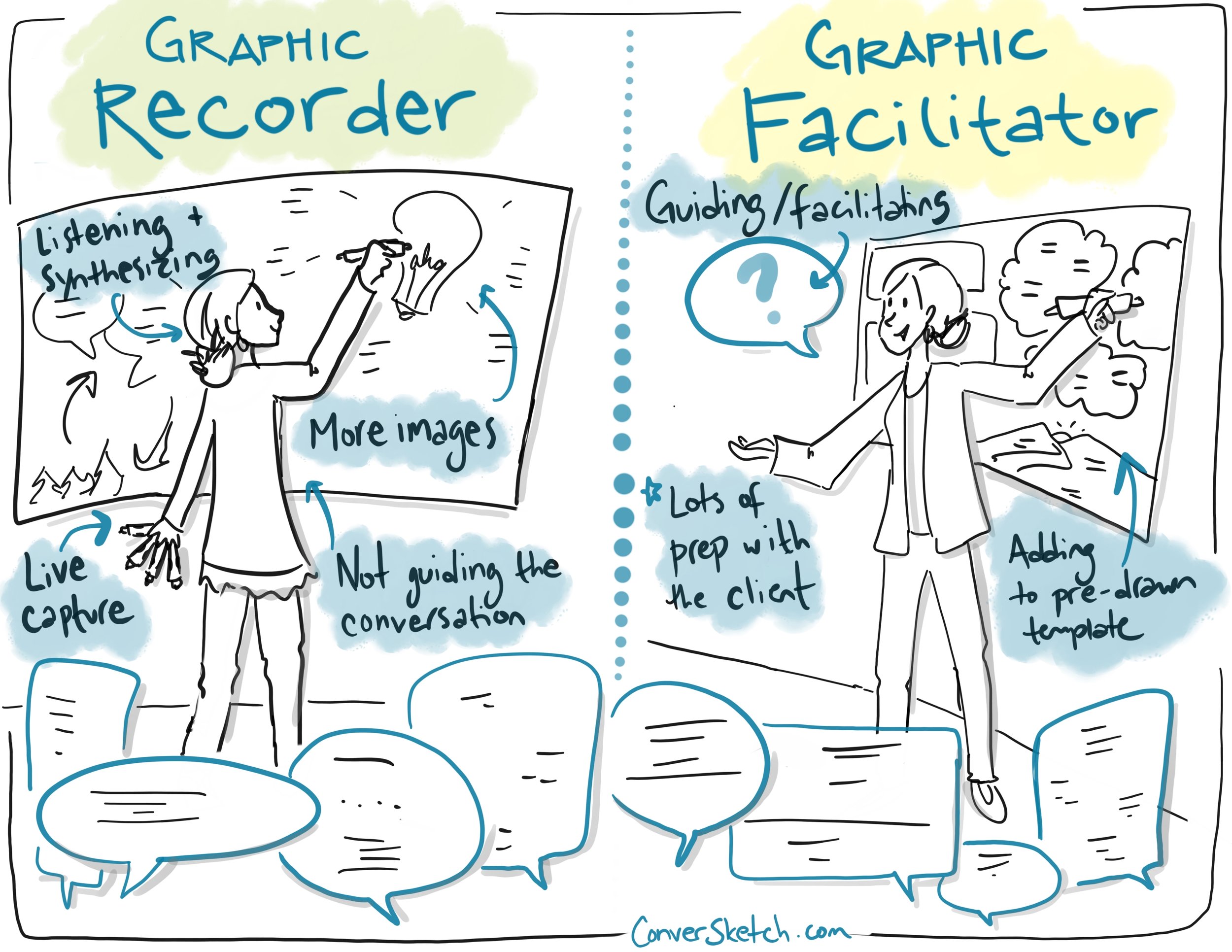
Graphic Recorder

As a graphic recorder, my main focus is live visual capture of content discussed or presented during an event. I have 1-2 planning calls with my client to understand their goals for including a graphic recorder, and to make sure I understand expectations. I’m a (mostly quiet) partner and resource to the facilitator running the meeting. During the event, my charts tend to have more illustrations than when I’m facilitating because that’s what I’m entirely focused on. A note here: although the word "facilitation" is not in the job title here, graphic recorders are often playing a very important role in the facilitation process, supporting groups and the "official" facilitator as a partner in a very unique and useful visual way. After the event, you keep the original drawings, I photograph and edit the digital images of the charts and send you a list of suggestions for how to leverage them tailored to you based on our conversations.

Graphic Facilitator

As a graphic facilitator, my relationship with the client is more involved because not only am I capturing key content visually during the event, I’m also working with you to design the process, facilitate the event, and make sure your next steps are clear. We have 3-5 planning calls (and a lot more emails) as we co-create an agenda that will help your group reach its’ goals, think about how to make the most of the visuals, and make sure the space will support the group to do their best thinking. I often spend lots of time preparing large-scale visual “templates” we can fill in together during the meeting (although not always, sometimes we start with a blank sheet too), and can create custom worksheets for the participants. And, because drawing can be such a powerful tool to clarify and deepen idea development, graphic facilitators might design activities and processes to get the participants drawing out their ideas to build shared understanding. During the meeting, I am facilitating the process, checking in to make sure we’re on track, and capturing content visually, but often these charts have more words than pictures as I’m balancing both the capture and guiding the discussion. Again, after the event you keep the original drawings, I photograph and edit the digital images of the charts and send you a list of suggestions for how to leverage them tailored to you, along with a short 1-2 page summary and suggested action steps.

Graphic Recorder or Graphic Facilitator.jpg

To make it even more interesting, some people use these terms interchangeably (i.e. they only use graphic facilitator even if they are solely focusing on visual capture), while others like me differentiate between the two. I think it's true that any sort of visual capture is a form of facilitation. Ultimately, I like to use the language that resonates with my clients and that they’ll remember, so yes, I do respond to “the artist”, “the graphic artist”, and “the woman with witty puns”. Again, these are only two options, but they can be confusing if you're new to visual lingo.

So, ask yourself, do you need a guide for the process? Or someone to focus entirely on visual capture? Both are useful in different situations. In the end, it’s important to have a conversation with the person you’re considering partnering with to be clear on expectations and to be sure you get set up for success!

Once again, thank you from my heart and soul for your support, great senses of humor, brilliant minds, collaboration and what you're each doing to make the world a better place.

Cheers, Karina

Now that I know the difference, I’d like to talk more about…

Graphic Recording and/or Graphic Facilitation

Where in the World is ConverSketch?

bikablo hosted by conversketch

Last week I had the pleasure of being a partner and host for Frank and Carola, two trainers from Germany who teach the bikablo visual thinking method all over Europe. This summer, for the first time bikablo came to the US on an 8 stop tour, including Fort Collins. The training was a success, and we are looking into partnering for future training opportunities in Colorado! Thanks to the wonderful Wolverine Farm Letterpress & Publick House for the excellent venue!

Should You Hire a Graphic Recorder? Ask Yourself These Questions to Decide

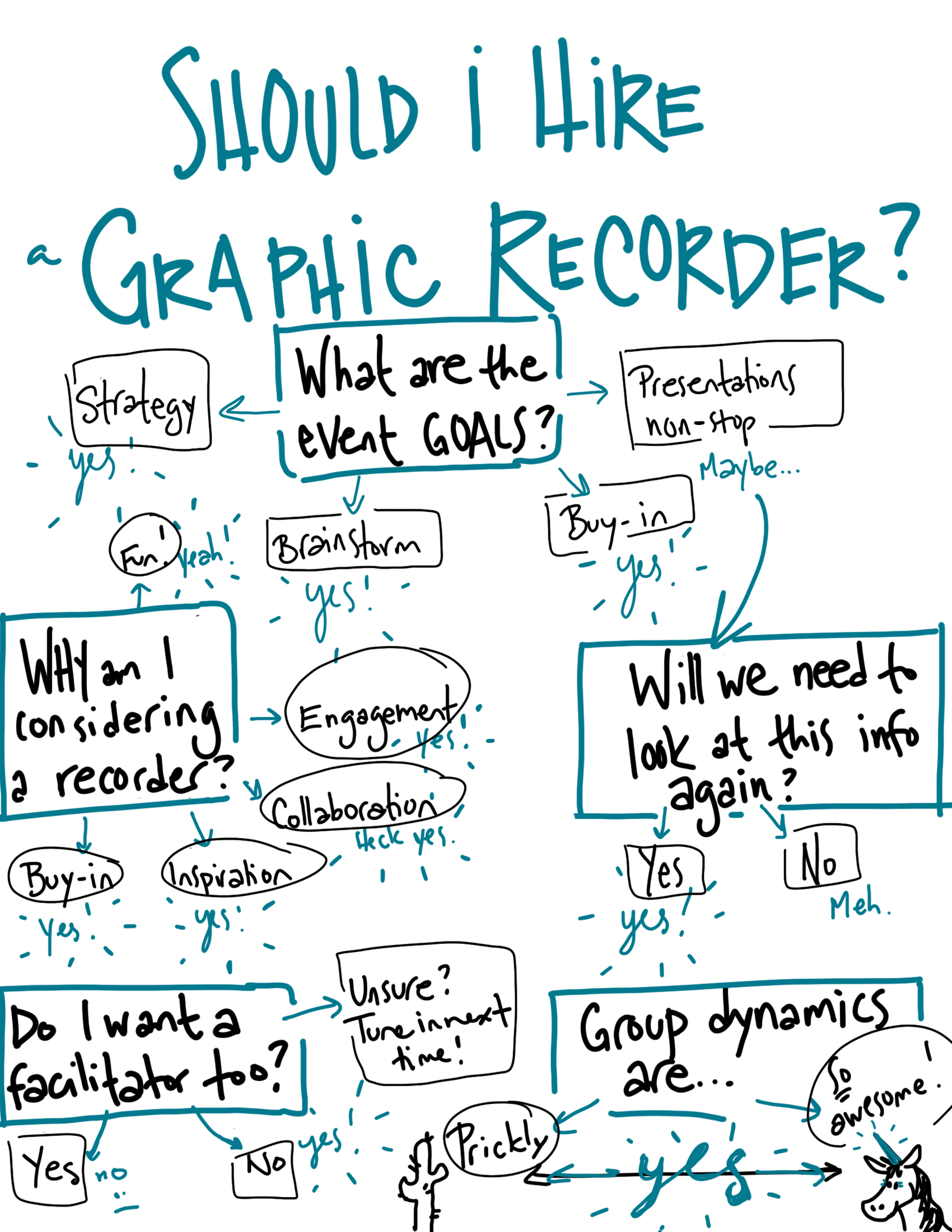
As tempting as it is to impress upon you, my lovely readers, that really there’s never a bad time for a graphic recorder, some events and meetings are better suited than others to have visual support. So, to help you decide if bringing in a graphic recorder is a good idea, here are some guiding questions for you and your team:

What are my goals for this event?

Do you want to co-create a strategic plan? Brainstorm and prioritize new ideas? Bring together a new group and hope they leave as a team? Share the state of the science for your field?  If there’s complex information, you want to get a group on the same page, or keynote presentations that can inform future discussions, graphic recording is right for you.

It may not be a good fit if there will be back-to-back presentations with lots of slides and little or no time to discuss the content*, or you’re only looking to get caricatures of everyone on the team. A graphic recorder’s number one goal is to capture key content in a way that makes it more accessible to the group, which often means an illustration, but not always. And if there will be simultaneous sessions you want captured, then plan to hire a team of recorders.

*An exception would be if you plan to build on the content later.

Why am I considering a graphic recorder?

Do you want to engage people during technical discussions? To keep them collaborating after the event? To work through a complex challenge? To make your event or meeting stand out amongst a sea of others? Finding someone who has the right amount of technical understanding and can design work that will truly support the group as they move forward can be integral to the success of the group.

Will we need to look at or build on this later?

Graphic recording provides succinct maps of the conversation or presentations that are actually interesting to look at and build on. I also work with each of my clients to create a tailored list of suggestions for how to leverage the charts after the event. What action (if any) is desired after the event? How can you keep people engaged and motivated around the meeting ideas? How will people communicate what they’ve learned to those who weren’t there? Graphic recording can be an extremely powerful tool not only during, but long after the event when used well.

How well does this group know each other? Are they good at collaborating already, or are they newly formed? Is there history?

Graphic recording can be a power boost tool for established groups, and can be even more powerful for new groups just forming. When people see their ideas and know others in the group also see them, they feel heard, and move from thinking of it as “my idea” to “our ideas”. Facilitating this kind of collaborative thinking early on in the team’s existence can save time, build trust, and get things moving faster, even if there is “history” or “baggage” between some group members.

Am I looking for someone to design the process & be a neutral lead in the discussion too?

If so, you’re looking for a facilitator, which is great! Graphic recorders are wonderful team players and work well with facilitators to more deeply understand the process and create visuals to support the group.

should-i-hire-a-graphic-recorder-decision-chart

One more thing…

Keep in mind that if you’ve roped in a good graphic recorder, the sooner you engage with them in the meeting design process the better as we can help you figure out where in the agenda graphic recording can provide the most for your participants. Of course, we’re really flexible and good at adapting on the fly, so if it’s a last-minute decision, we can usually roll with it and still rock your world.

At this point, if you happen to be wondering what the difference between a graphic recorder and a graphic facilitator is, you’re in luck, because that’s what I’ll be writing about in a couple of weeks!

Once again, thank you from my heart and soul for your support, humor, brilliant minds, collaboration and what you're each doing to make the world a better place.

Cheers, Karina

Sounds like I could use a graphic recorder for my next event!

Let’s hear about it.

Where in the World is ConverSketch?

Bikablo – One More Spot!We’ve just opened one more spot for the 2-day immersive Bikablo Visual Facilitation training August 15-16 in Fort Collins, Colorado. Click here to find out more and register!

Bikablo – One More Spot!

We’ve just opened one more spot for the 2-day immersive Bikablo Visual Facilitation training August 15-16 in Fort Collins, Colorado. Click here to find out more and register!

The Cache la Poudre CanyonLast week I had the distinct pleasure of a new experience with my US Forest Service clients – I got to camp out with them before graphic facilitating a mostly-outdoors retreat! An inspiring and beautiful location can go a l…

The Cache la Poudre Canyon

Last week I had the distinct pleasure of a new experience with my US Forest Service clients – I got to camp out with them before graphic facilitating a mostly-outdoors retreat! An inspiring and beautiful location can go a long way for inspiring innovative and collaborative ideas!

How to Make the Most of Meetings

No matter who you are or where you work, you go to meetings. There is a spectrum of how you feel about meetings. It looks like this:

graphic-recording-feelings-about-meetings-spectrum

My goal with this post is to move you, at least a little, from the eel side to the OMG side of things by sharing some tips on how to make your meetings effective, useful, and fun.

Purpose.

  • Always have a clear goal or purpose for the meeting, and make sure everyone knows.
  • Always have an agenda (even if it’s just “5-minute update from both teams”). Again, make sure everyone knows.

Timing.

  • Create an expectation that meetings start and end on time, and stick to it.
  • Limit meetings to 30 minutes and see what you can actually do with that focused time.
  • Start meetings at an unusual time, like 1:36 pm.
  • How do you make sure to stay on time? Read on…

Technology.

  • Place a Phone Basket by the door and have everyone, including leadership, put their phones in there.

Consequences.

  • To ensure these guidelines are respected, institute consequences – positive or negative – for behaviors that support or undermine being on time.
  • For example, if you’re late, do 10 pushups for every late minute or you have to sing a song in front of the group.
  • If you are the reason a meeting goes long, you have to buy a round of drinks for everyone, or bring coffee for everyone next time.
  • If a phone rings during the meeting, the person needs to make a donation to a non-profit of choice.

Bring in a graphic recorder or graphic facilitator.

  • Your team will be able to wade through complexity more quickly and easily by seeing the conversation take place in front of them.
  • People stay engaged and better remember key ideas from the meeting.
  • Seeking connections and working collaboratively become second nature to the group.
  • Having a tangible map of what was achieved helps keep people focused and action-oriented after the meeting is over.

To me, the key for success here is building these behaviors and expectations into the organization’s culture.

graphic-recording-how-to-make-meetings-beter

For more great tips on effective meetings, read this article from Fast Company.

Once again, thank you from my heart and soul for your support, great senses of humor, brilliant minds, collaboration and what you're each doing to make the world a better place.

Cheers, Karina

Interested in hosting the most interesting meetings in the world?

Cheers to that!

Where in the World is ConverSketch?

This week I’m out East in the DC area with the NSA again. We’re talking leadership, resiliency, and management styles and how to help teams work better together.

This week I’m out East in the DC area with the NSA again. We’re talking leadership, resiliency, and management styles and how to help teams work better together.